Joint Capsule

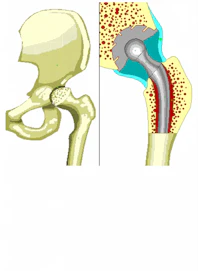
A joint capsule is a thin, fibrous sac containing fluid, which encloses a joint. The fluid provides lubrication for bone movement. Most joints in the human body are freely movable and have much more complex structures than the immovable or even the slightly movable types. The articular (adjoining) ends of bones in a freely movable joint are covered with a thick layer of articular cartilage, which is resistant to wear and produces a minimum of friction when it is compressed as the joint is moved. A tubular joint capsule that has two distinct layers holds joint bones together. The outer layer consists mostly of dense, white, fibrous connective tissue, the fibers of which are attached to the periosteum around the outside ring of each bone of the joint near its articular end. The outer fibrous layer of the capsule, therefore, completely encloses the other parts of the joint. It is flexible enough, though, to allow movement and strong enough to help prevent the articular surfaces from being pulled apart. Bundles of strong, tough collagenous fibers called ligaments reinforce the joint capsule and help to bind the articular ends of the bones together. Some ligaments appear as bulges in the fibrous layer of the capsule, while others are accessory structures located outside the capsule. In either case, these structures also prevent too much movement at the joint, because the ligament is relatively inelastic and becomes tightly drawn whenever a normal limit of movement has been achieved in the joint. The inner layer of the joint capsule consists of a shiny, vascular lining of loose connective tissue called synovial membrane. The membrane covers all of the surfaces within the joint capsule, except the areas that are covered by cartilage. Some freely movable joints are partially or completely divided into two compartments by disks of fibrocartilage called menisci located between the articular surfaces. Such a disk is attached to the fibrous layer of the joint capsule at the sides, and its free surface projects into the joint cavity. Certain freely movable joints also have closed, fluid-filled sacs called bursae associated with them. Each bursa has an inner lining of synovial membrane, which may be continuous with the synovial membrane of a nearby joint cavity. Bursae act as cushions and aid the movement of tendons, which glide over such bony parts or over other tendons. The names of the bursae indicate their locations; for example, a suprapatellar bursa, a prepatellar bursa, and an infrapatellar bursa.

Copyright © Innerbody Research 1997 - 2025. All Rights Reserved.